The Automation Paradox: Why Fundamentals Still Matter

As someone who works in automation, I see the appeal of the “hands-off” future every day. The common narrative is simple: if a job happens on a screen, AI will eventually take it over.
But there’s a big gap between generating a solution and keeping a system running reliably.
From my experience in rail infrastructure and reliability engineering, I’ve learned that the idea of “perfect” AI doesn’t really exist. Hallucinations happen. Outputs can look convincing while still being wrong. And judging quality, especially when it’s subjective, is far harder to automate than people assume.
AI as the Engine, Humans as the Rails
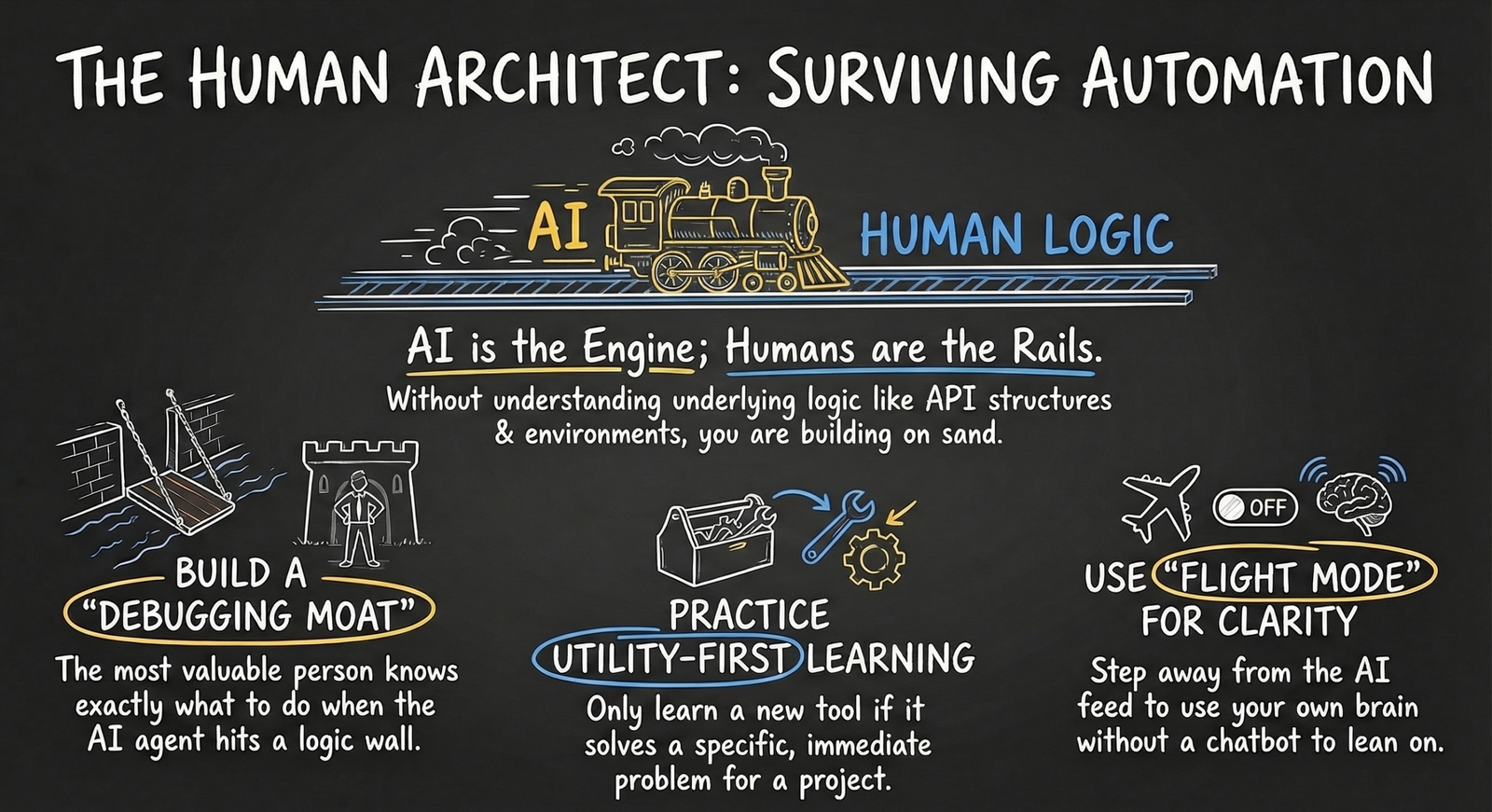
AI can help build complex workflows quickly. But if you don’t understand what’s underneath—things like the Linux environment, APIs, or reliability standards like RAMS—you’re basically building on unstable ground.
AI might produce the engine. But someone still has to lay the rails.
The Real Moat: Debugging
The job market is shifting in an interesting way.
The most valuable person isn’t necessarily the one writing the best prompts. It’s the person who knows what to do when the system breaks. When the AI agent fails. When the logic stops making sense.
That’s where experience and fundamentals still matter.
Dealing With the “Always Behind” Feeling
The pace of AI news can be overwhelming. New models, new tools, new frameworks. Every week something is supposedly “game-changing.”
It’s easy to fall into a loop of constant catching up. Eventually it leads to burnout, especially for people who naturally enjoy learning new tech.
A few habits have helped me stay grounded.
Learn With a Purpose
I don’t pick up tools just because they’re trending online. I learn them when they solve a real problem.
Right now, for example, most of what I’m learning ties directly to automation for lead generation campaigns. If a tool doesn’t help with that, it can wait.
Step Away From the Feed
Sometimes the best reset is simply stepping away from the AI noise.
A few hours without constantly checking tools or prompts forces you to think again. Ironically, that’s often when better ideas show up.
Be Honest About the Learning Curve
No one has everything figured out yet.
Whether someone has five followers or five million, everyone is still experimenting. Admitting that a tool is confusing, frustrating, or just not very good yet is far more useful than pretending to be an expert.
Looking Ahead
2026 doesn’t have to be the year people get replaced. It can also be the year many people get freed from the repetitive parts of their work.
Photography didn’t kill painting. It just pushed artists in new directions.
AI might do something similar. It can remove a lot of the tedious “glue work” in systems engineering and automation, leaving more room to focus on design, architecture, and creative problem solving.
At the end of the day, tools don’t define us. What matters is curiosity, persistence, and the ability to turn machine output into something that actually works for people.
For the rest of this year, my plan is simple: stay hands-on, keep experimenting, and remember that good systems and good people will always matter more than raw speed.